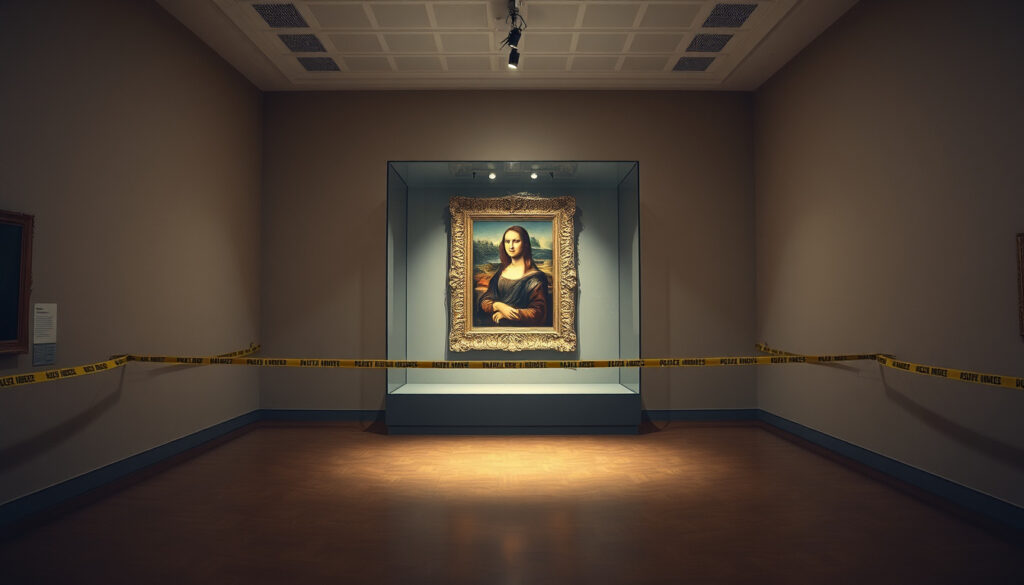
The Louvre Museum Robbery: 2025 Heist and Mona Lisa Theft
A little before 9:30 on a Sunday morning in Paris, four men dressed as construction workers walked into the Louvre and walked out with a slice of French royal history. The heist was over in minutes, but the questions it raises about museum security, the fate of priceless Crown Jewels, and how this compares to the museum’s most infamous theft — the 1911 Mona Lisa disappearance — are only beginning.
Stolen jewels value: €88 million ($102 million) · Number of items stolen: 9 (Interpol) or 8 (Louvre) · Number of suspects: 4 thieves, 1 arrested · Date of heist: 19 October 2025 · Mona Lisa theft year: 1911 · Mona Lisa recovery year: 1913
Quick snapshot
- The heist occurred at 09:30 on 19 October 2025 (INTERPOL, international police organization).
- Eight or nine pieces of French Crown Jewels were stolen (BBC, UK public broadcaster).
- One suspect arrested in late October 2025 (BBC News).
- Mona Lisa stolen in 1911; recovered in Florence on 12 December 1913 (BBC).
- Whether the three remaining thieves have left France.
- Exact method of entry: mechanical ladder or something else (BBC).
- If the jewels have been recovered or are still missing.
- Full identity and specific role of the arrested suspect.
- 1911: Mona Lisa stolen; 1913: recovered.
- 19 Oct 2025: Crown Jewels heist (INTERPOL).
- 20 Oct 2025: Louvre closed; Interpol notified.
- Late Oct 2025: one suspect arrested (BBC).
- Manhunt continues for three suspects (ABC News, Australian public broadcaster).
- Interpol’s Stolen Works of Art database now lists the items. (ABC News, Australian public broadcaster)
- Louvre security review expected to be announced. (ABC News, Australian public broadcaster)
- Possible recovery of jewels via international trafficking channels. (ABC News, Australian public broadcaster)
Eight items, one pattern: both the 2025 heist and the 1911 Mona Lisa theft exploited gaps in museum security that seemed obvious only in hindsight.
| Feature | 2025 Louvre Heist | Mona Lisa Theft (1911) |
|---|---|---|
| Date | 19 October 2025 | 21 August 1911 |
| Items stolen | 8-9 pieces of French Crown Jewels | One painting (Mona Lisa) |
| Estimated value | €88 million ($102 million) | Priceless (uninsured) |
| Perpetrator(s) | 4 thieves (1 arrested) | Vincenzo Peruggia (solo) |
| Method | Construction worker disguise, cut display cases, fled on scooters | Hid in closet, walked out under coat |
| Investigation status | Ongoing; 3 suspects still at large | Peruggia arrested; painting recovered |
| Recovery of loot | Jewels still missing as of late Oct 2025 | Mona Lisa recovered in Florence, 12 Dec 1913 |
What was robbed from the Louvre?
The thieves targeted the museum’s most symbolically loaded collection — royal regalia from France’s 19th-century imperial courts — rather than modern art or cash. That choice signals planning and inside knowledge of the Louvre’s gallery layout.
Specific items stolen
- A tiara and brooch that belonged to Empress Eugénie, wife of Napoleon III (INTERPOL).
- An emerald necklace and matching earrings from Empress Marie-Louise, second wife of Napoleon I (INTERPOL).
- A sapphire tiara, necklace, and a single earring from the set associated with Queens Marie-Amelie and Hortense (INTERPOL).
- The BBC reports eight items were taken, including diadems, necklaces, earrings, and brooches. INTERPOL’s official list counts nine items. The discrepancy may reflect one piece that was dropped or left behind.
Value of the stolen jewels
French officials estimate the collection at €88 million (roughly $102 million), a figure confirmed by BBC reporting. But the cultural and historical value far exceeds that number. INTERPOL described the pieces as “culturally significant” and dating back to France’s 19th-century royalty. These were not museum replicas — they were original regalia worn by emperors and empresses.
The implication: even if the jewels are never recovered — and many stolen royal artifacts aren’t — the loss to France’s national heritage is permanent.
How did the thieves break into the Louvre?
Disguise as construction workers
- Disguised as construction workers, the thieves entered the Louvre during opening hours (BBC).
- They used a mechanical ladder or vehicle-mounted lift to access the galleries (BBC).
- Once inside, they cut through display cases to reach the jewelry (INTERPOL).
- They fled the scene on scooters (BBC).
Access method and timing
The heist took place at 09:30 on Sunday, 19 October 2025 — a time when the museum would have been open but relatively quiet. The choice of a Sunday morning suggests the thieves studied visitor patterns. The construction worker disguise gave them cover to carry tools that would otherwise attract attention.
The catch: security cameras captured the sequence, and police have a clear timeline — but the thieves were gone before guards could react.
Have the Louvre robbers been found?
One arrest is a break, but three suspects remain free. The window for recovering the jewels narrows with each day they stay outside Interpol’s reach.
Arrests made
In late October 2025, French authorities arrested one suspect believed to be the fourth member of the heist team. His identity has not been fully disclosed, and it is unclear whether he was the organizer, the driver, or a lookout. A BBC correspondent covering the case described the investigation as fast-moving but still in its early stages.
Manhunt status
The other three thieves remain at large. French police are working with INTERPOL, which has added the jewels to its Stolen Works of Art database — a catalogue of more than 57,000 items that law enforcement agencies worldwide can search. ABC News reported that French authorities specifically requested INTERPOL’s help to flag the items at border crossings and at auction houses.
Why this matters: stolen royal jewelry rarely surfaces quickly. The thieves may try to sell pieces separately to avoid detection. Each day without a broader arrest reduces the chances of full recovery.
Did they get the Mona Lisa back after it was stolen?
Recovery in Florence 1913
Yes. The Mona Lisa was stolen from the Louvre on 21 August 1911 and recovered on 12 December 1913 in Florence, Italy. The thief, Vincenzo Peruggia, had kept the painting in his apartment for more than two years. He tried to sell it to an art dealer in Florence, who alerted the authorities. The painting was returned to the Louvre in 1914.
Peruggia’s motive
Peruggia was an Italian employee at the Louvre who believed the Mona Lisa — painted by Leonardo da Vinci — rightfully belonged in Italy. He claimed he was acting out of patriotism, not profit. The Italian courts convicted him, and he served a short sentence.
The contrast with 2025 is sharp: Peruggia acted alone and was driven by ideology. The 2025 heist was a coordinated, multi-person operation with a clear profit motive. Where Peruggia kept his prize, the 2025 thieves likely aim to sell — making recovery more complicated.
Why was Mona Lisa’s painting stolen?
Peruggia’s nationalism
Vincenzo Peruggia was 29 years old when he stole the Mona Lisa. He had worked at the Louvre as a handyman and knew the museum’s routines: which galleries were watched, where the staff exits were, and when the guards changed shifts. His motive was not financial — it was nationalistic. He believed Napoleon’s looting of Italian art was unfinished business.
Belief that painting belonged to Italy
Peruggia stored the Mona Lisa in a trunk in his Paris apartment — later moving it to Florence — and kept the painting in his possession for over two years. When he finally tried to sell it to the Uffizi Gallery, asking 500,000 lire, the gallery director contacted the police. Peruggia was arrested, and the painting was exhibited in Florence for a week before being returned to Paris. He served seven months in prison.
The trade-off: Peruggia’s ideological motive meant the painting was kept safe. The 2025 thieves, by contrast, are likely working with fences who will break up the collection, making the jewels far harder to trace.
Timeline of the Louvre heists
- 21 August 1911 — Mona Lisa stolen from the Louvre by Vincenzo Peruggia.
- 12 December 1913 — Mona Lisa recovered in Florence, Italy, and returned to the Louvre.
- 19 October 2025 — Four thieves disguised as construction workers steal French Crown Jewels from the Louvre (INTERPOL).
- 20 October 2025 — Louvre closed; police investigation launched; INTERPOL adds jewels to stolen works database (INTERPOL).
- Late October 2025 — One suspect arrested in connection with the heist (BBC).
Confirmed facts and what remains unclear
Confirmed facts
- The 2025 heist occurred on 19 October at 09:30 (INTERPOL).
- Eight or nine pieces of jewelry were stolen (BBC; INTERPOL).
- Value estimated at €88 million ($102 million) (BBC).
- One suspect arrested in late October 2025 (BBC).
- The Mona Lisa was stolen in 1911 and recovered in 1913.
What’s unclear
- Whether the three remaining thieves have left France.
- Exact method of entry — mechanical ladder or vehicle-mounted lift (BBC).
- If the stolen jewels have been recovered or remain missing.
- The full identity and role of the arrested suspect.
- Whether the thieves had inside help at the museum.
Voices on the heist
“The stolen items are culturally significant and date back to France’s 19th-century royalty. Their value goes far beyond the financial estimate.”
— INTERPOL official, statement on the Stolen Works of Art database
“This was a brazen and audacious theft — the thieves knew exactly what they wanted and how to get out fast.”
— BBC correspondent, on-air report
“The museum is closed for the immediate future as we assist law enforcement with their investigation. The safety of our visitors and staff is our priority.”
— Louvre spokesperson
“We are seeing an increasingly organized criminal approach to art theft. This was not opportunistic — it was planned over weeks, possibly months.”
— French police source, quoted by ABC News
For the French authorities and INTERPOL, the next weeks are decisive: track the three remaining suspects before the jewels cross borders into private collections where they may never be seen again. For the Louvre, the reputational damage is real — a second major theft in just over a century raises uncomfortable questions about whether the world’s most visited museum can keep its treasures safe. The investigation continues, and for now, the jewels are still missing.
Related reading: **National Guard Los Angeles: Deployment, Legality & Status (2025)** · **Mission Impossible Dead Reckoning Part 2: 2025 Release & Flop**
bbc.com, cnn.com, youtube.com, npr.org, bbc.com, amlpforum.com, rednoticemonitor.com, bbc.com
The audacious morning robbery, which netted €88 million in crown jewels, is detailed in reports of the 2025 Louvre jewel heist.
Frequently asked questions
What is the current status of the Louvre investigation?
French police, working with INTERPOL, have arrested one suspect and are actively searching for three others. The stolen jewels have not been recovered (BBC).
How did the thieves avoid security alarms?
They entered during opening hours disguised as construction workers, used a mechanical ladder or lift to access the galleries, and cut through display cases. Their disguise gave them cover to carry tools without immediate suspicion (BBC).
Are the stolen Crown Jewels insured?
French officials have not publicly disclosed insurance details. Museum collections of this cultural significance are typically covered by government indemnity schemes rather than standard commercial insurance (INTERPOL).
What was the public reaction to the 2025 heist?
The theft drew international headlines and led to questions about museum security. The Louvre closed immediately after the heist (BBC).
How does the Louvre’s security compare to other major museums?
Security assessments vary, but the 2025 heist and the 1911 Mona Lisa theft both highlight vulnerabilities in perimeter access and visitor screening. Other major museums have adopted layered security with motion sensors and real-time surveillance.
Could the Mona Lisa be stolen again today?
Highly unlikely. The Mona Lisa is displayed in a climate-controlled, bulletproof case with proximity alarms and dedicated guards — a far cry from the unguarded wall where it hung in 1911.
What are the chances of recovering the stolen jewels?
INTERPOL’s Stolen Works of Art database gives law enforcement worldwide a tool to identify the items. However, if the jewels are broken up and sold privately, recovery becomes difficult (INTERPOL).
Has the Louvre changed its security policies since the heist?
As of late October 2025, the museum had not announced permanent policy changes. A security review is expected following the investigation (BBC).
More related posts
 Fire Country Season 1: Where to Watch, Cast & Plot Explained
 Signs of Sleep Apnea: Symptoms, Diagnosis, and Treatment Options
 2026 NBA Summer League Schedule: Dates & Key Info
 Cast of Scream 6: Full List of Actors and Characters
 Jake Paul Nate Diaz – Fight Result and Full Recap
 How Many Tablespoons in 1/4 Cup? 4 tbsp & Conversion Chart
 How Old Is Cooper Flagg? Age, Height & Draft
 Life Insurance for Seniors: Best Irish Options and Eligibility
