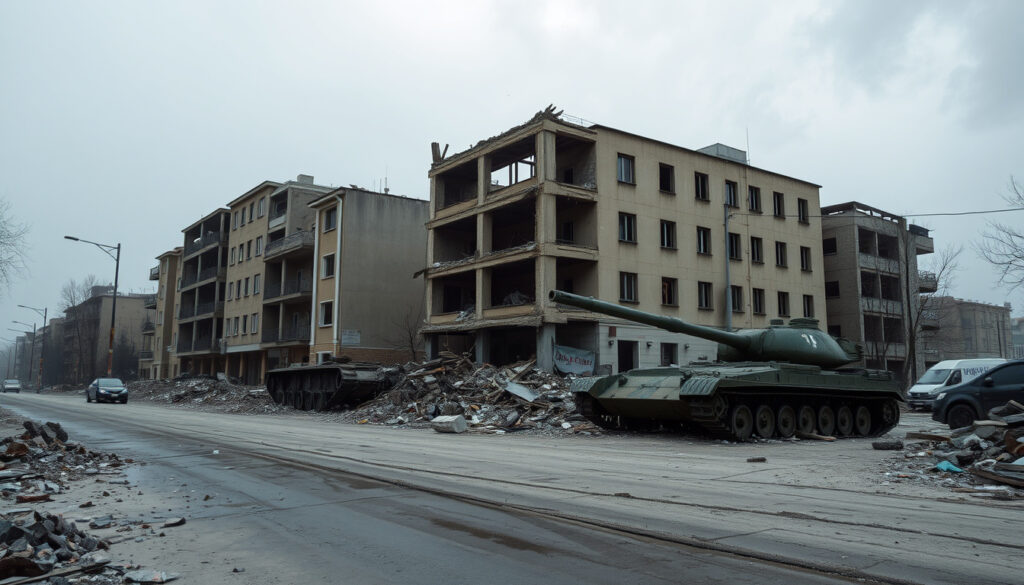
Why Is Russia Attacking Ukraine? Reasons and Goals Explained
Russia’s full-scale invasion of Ukraine on February 24, 2022, was publicly justified as demilitarization and denazification, but Western intelligence has consistently assessed deeper imperial ambitions — a contradiction that lies at the heart of the war. From NATO expansion to imperial restoration, the reasons are layered and essential to understanding the conflict that has reshaped Europe.
War duration: 4+ years since 2022 full-scale invasion ·
Annual U.S. aid to Ukraine: over $100 billion since 2022 ·
Russian territorial gains in 2024: slow incremental advances in Donbas ·
Estimated casualties (both sides): hundreds of thousands killed or wounded
Quick snapshot
- Russia invaded Ukraine on February 24, 2022 (Council on Foreign Relations)
- Crimea annexed in 2014, and Russia occupies ~18% of Ukraine (United Nations)
- Putin reiterated “root causes” at September 2025 SCO summit, pushing for regime change (CSIS)
- Ongoing attrition war with slow Russian gains in Donbas and continued Western military aid (Institute for the Study of War)
Six key facts set the stage for understanding the conflict’s scope:
| Fact | Value |
|---|---|
| Full‑scale invasion date | February 24, 2022 |
| Territory occupied by Russia (2025) | ~18% of Ukraine (including Crimea) |
| Russian military fatalities (estimated) | over 200,000 (as of late 2024) |
| Ukrainian military fatalities (estimated) | over 100,000 (as of late 2024) |
| Total Ukrainian refugees | over 6 million registered abroad |
What is the main reason Russia is fighting Ukraine?
The Kremlin publicly blames NATO expansion, but Western intelligence agencies have assessed since 2023 that Moscow’s real motive is imperial control over Ukraine — not defensive security.
Kremlin’s stated justifications
- Putin’s February 2022 speech announced a “special military operation” to “demilitarize” and “denazify” Ukraine (Council on Foreign Relations, conflict tracker).
- Moscow claims it must protect Russian speakers in Donbas and prevent Ukraine from joining NATO, portraying the alliance as an existential threat.
- In December 2025, Putin reiterated maximalist war aims including regime change in Kyiv (Institute for the Study of War, daily assessment).
Western analysis of Moscow’s real motives
- Declassified U.S. intelligence has found that NATO enlargement was not a direct threat to Russia — contradicting the Kremlin’s narrative.
- The Center for Strategic and International Studies assesses that Putin seeks “regime change” via elections as a precondition for peace, aiming to install a pro‑Kremlin government (CSIS).
- Global Affairs Canada, in a 2025 statement, said Russia’s goal has remained “to subjugate Ukraine” throughout the war (Government of Canada, official statement).
The implication: Russia’s stated security concerns serve as a cover for an imperial project. The pattern — invade, occupy, demand regime change — fits a long‑standing Kremlin playbook applied in Georgia (2008) and Crimea (2014).
What are Russia’s demands for Ukraine?
Territorial demands
- Recognition of Crimea as Russian (claimed in 2014) and the four annexations of Donetsk, Luhansk, Zaporizhzhia, and Kherson as legitimate parts of Russia.
- Reports suggest the Kremlin has designs on further expansion, including toward Sumy and Dnepropetrovsk regions (CSIS, low‑confidence but noted assessment).
Political demands
- Ukraine must enshrine neutrality in its constitution, renouncing NATO membership forever.
- Demilitarization: severe limits on Ukraine’s army size and weapons, effectively making it defenseless.
- A de‑facto Russian veto on Ukraine’s foreign policy and security arrangements.
Security demands
- Lifting of Western sanctions imposed on Russia since 2014 and 2022.
- Legal guarantees that Ukraine will never host foreign troops or bases.
What this means: If accepted, these demands would turn Ukraine into a vassal state, giving Moscow permanent control over its sovereignty — a prospect the UN Secretary‑General called a violation of “Ukraine’s independence and territorial integrity” (United Nations, statement February 2025).
What is Russia’s goal against Ukraine?
Short‑term tactical gains in Donbas hide a dark long‑term goal: erasing Ukraine as an independent state and preventing any Western alignment.
Short-term military objectives
- CSIS reports that Russia’s 2025 campaign aims to seize the remaining towns in Donetsk oblast, where Ukraine still controls about 25% of the territory (CSIS, September 2025 assessment).
- Summer 2025 offensives brought tactical gains but no strategic breakthrough (CSIS).
Long-term geopolitical aims
- Regime change in Kyiv remains the ultimate prize, per ISW and CSIS analyses.
- Prevent Ukraine’s integration into NATO and the European Union — a move that would lock Russia out of the Black Sea region’s security architecture.
- Undermine NATO unity by exposing divisions over aid and strategy.
The trade‑off: Russia is trading enormous casualties for incremental land gains. With over 200,000 killed (CSIS, estimates as of late 2024), the cost is staggering, but the Kremlin shows no sign of abandoning its maximalist goals.
Why do Russians support the war in Ukraine?
State propaganda and information control
- The Kremlin frames the war as a defensive necessity against a NATO‑backed “Nazi regime” in Ukraine, a narrative repeated relentlessly on state television.
- Independent polling is banned, but leaked surveys suggest war fatigue grows, with high approval of the “special military operation” only among those fully immersed in state media.
Historical narratives and national identity
- Soviet nostalgia and anti‑Western resentment fuel support, especially among older generations.
- Putin’s claim that Ukraine is “an artificial state” created by Lenin resonates with imperial‑minded nationalists.
The catch: Opposition is risky — dissenters face prison under wartime censorship laws. The Kremlin has used the war to crush dissent and rally patriotic sentiment, making genuine anti‑war movements near impossible.
Why is Russia doing so badly against Ukraine?
Military miscalculations
- The initial blitz on Kyiv in 2022 failed spectacularly due to poor logistics, troop morale issues, and Ukrainian resistance.
- Western intelligence assessments declassified in 2023 revealed that Russia underestimated Ukrainian will to fight and overestimated its own army’s capabilities.
Ukrainian resistance and Western aid
- Ukraine received over $100 billion in U.S. military aid since 2022, including HIMARS, Leopard tanks, and F‑16 training.
- Ukrainian morale and Western training created a fighting force that has out‑maneuvered Russian forces in key battles (Kharkiv 2022, Kherson 2022).
- Western sanctions have degraded Russia’s ability to produce precision munitions, forcing reliance on older Soviet‑era stocks (CSIS, analysis of military industrial impact).
What this means: Russia’s poor performance is a compound failure of strategic planning, intelligence, and logistics — not a lack of will. But as Western aid wavers, Ukraine’s advantage could erode, giving Russia a chance to turn its grind into eventual gains.
Timeline: Key events in the Russia‑Ukraine war
- 2013‑2014: Euromaidan protests and Russian annexation of Crimea; Donbas separatist war begins.
- 2014‑2021: Minsk agreements fail; low‑intensity conflict kills over 14,000.
- February 2022: Full‑scale invasion launched from multiple axes.
- 2022‑2023: Ukraine liberates Kharkiv and Kherson; Russia digs in in Donbas.
- 2024: Attrition war; Russia makes slow advances; Ukraine strikes inside Russia.
- 2025: Stalemate with ongoing negotiations; Russia’s maximalist demands remain.
What we know and what remains unclear
Confirmed facts
- Russia invaded on 24 February 2022 from multiple axes (United Nations, timeline)
- Crimea was annexed in 2014 after a referendum not recognized internationally (Council on Foreign Relations)
- Putin has stated Ukraine is not a legitimate state in multiple speeches (CSIS, analysis of Putin’s rhetoric)
- NATO not a direct threat per declassified US intelligence assessments
What’s unclear
- Precise number of casualties (both civilian and military) due to lack of independent verification
- Russia’s true intentions if Ukraine agreed to all territorial and political demands
- Duration of the war or conditions for a sustainable peace
- Whether Russia can sustain its current offensive tempo beyond 2025
Expert perspectives on the war
“We assess that Moscow’s strategic objective remains to subjugate Ukraine and prevent it from aligning with the West.”
— CSIS, Russia’s War in Ukraine: The Next Chapter
“Russia’s goal has remained to subjugate Ukraine throughout the war.”
“Peace must fully uphold Ukraine’s sovereignty, independence, and territorial integrity within its internationally recognized borders.”
— UN Secretary‑General, February 2025
For ordinary Ukrainians, the consequence is brutal: more years of displacement, death, and uncertainty. For the rest of Europe, the war has shattered the post‑Cold War security order. The pattern — Russia invokes historical grievances, issues maximalist demands, then escalates when rebuffed — has repeated itself twice now (Georgia 2008, Ukraine 2022). The only question left is whether the response this time will break the cycle or entrench it.
aljazeera.com, understandingwar.org, britannica.com, hnmcp.law.harvard.edu, understandingwar.org, youtube.com, aljazeera.com
Frequently Asked Questions
What triggered Russia’s full-scale invasion of Ukraine in 2022?
Russia launched the invasion on February 24, 2022, citing NATO expansion and alleged Ukrainian aggression toward Russian speakers. Western analysts assess the real trigger was Putin’s decision that Ukraine’s pro‑Western path threatened his regime’s control over the post‑Soviet space. (Council on Foreign Relations)
How is Russia justifying the war to its own people?
Moscow uses state‑controlled media to portray the war as a defensive “special military operation” against a Nazi‑backed enemy, claiming Ukraine is an artificial state and NATO is preparing to attack Russia. (CSIS, analysis of Russian propaganda)
What role does NATO play in the Russia-Ukraine conflict?
Russia claims NATO expansion provoked the invasion, but Western intelligence found no evidence of a direct threat. NATO’s open‑door policy is a key Kremlin grievance, though no NATO forces were stationed in Ukraine before 2022. (CSIS, assessment)
Is Russia winning or losing the war in Ukraine right now?
As of late 2025, Russia is making slow territorial gains in Donbas but has not achieved a breakthrough. Ukraine continues to resist with Western aid. The war is in an attrition phase, with neither side capable of a decisive victory. (Institute for the Study of War, December 2025)
What does Russia want from Ukraine to end the war?
Russia demands recognition of occupied territories, Ukrainian neutrality, demilitarization, and lifting of Western sanctions. In essence, it wants a government in Kyiv that will never join NATO or the EU and will accept Russian dominance. (CSIS, summary of demands)
How has the war affected the global economy?
Sanctions on Russia disrupted energy markets, caused food price spikes, and increased inflation worldwide. The war also accelerated Western efforts to reduce dependence on Russian oil and gas. (Council on Foreign Relations, global implications)
What is the difference between the 2014 war and the 2022 invasion?
The 2014 conflict was limited to Crimea and Donbas, with a relatively small number of troops. The 2022 invasion involved hundreds of thousands of Russian soldiers attacking from multiple axes, aiming to capture Kyiv and topple the government. (CSIS, historical comparison)
More related posts
 Healthy Paws Pet Insurance – Coverage Options and Benefits
 12 Years a Slave – True Story, Book vs Film Facts
 Hotel Transylvania 4 Cast – Full Voice Actors and Changes
 Couch to 5K Plan: Complete Beginner’s Guide
 Fire Country Season 1: Where to Watch, Cast & Plot Explained
 When is Columbus Day 2026? Date, History, and What’s Closed
 Remote Data Entry Jobs: How to Find Them in Ireland
