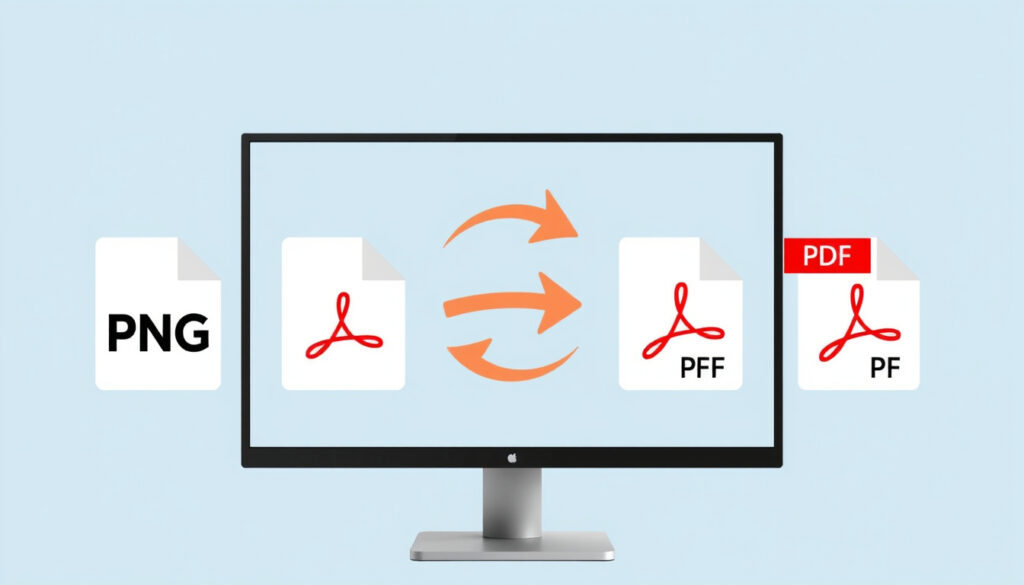
PNG to PDF Converter: Free Online Tools Compared (2025)
Finding a free way to turn a PNG into a PDF sounds simple, but between file limits, privacy policies, and hidden sign-up walls, the quick fix isn’t always the right one. This guide cuts through the noise to compare five honest, no-nonsense tools—Adobe Acrobat, Smallpdf, png2pdf.com, Canva, and Microsoft—so you can pick the one that actually fits your workflow without surprises.
Free PNG to PDF converters available online: over 50 ·
Supported image formats in leading tools: PNG, JPG, BMP, TIFF, SVG ·
Maximum number of images per PDF (common free tier): 10-20 ·
File size limit per image (Adobe Acrobat online): up to 100 MB ·
Platforms with dedicated Windows software: Microsoft Store, Adobe Acrobat
Quick snapshot
- Adobe Acrobat offers a free online converter with no registration required (Adobe Acrobat official product page)
- Smallpdf free tier requires no sign-up and deletes files after 1 hour (Smallpdf privacy policy)
- png2pdf.com supports batch upload of up to 20 images (png2pdf.com tool page)
- Whether file size limits for free tiers have changed recently across tools
- If Smallpdf free tier batch limit will remain at 2 files per hour
- Not applicable — no chronological event track
- Expect more tools to add client-side processing for privacy compliance
Five tools, one pattern: the convenience of free conversion comes at different costs.
| Tool | Free tier limits | Privacy & auto-deletion | Sign-up required |
|---|---|---|---|
| Adobe Acrobat | No file-size limit, no watermark (Adobe Acrobat official product page) | Auto-delete after 1 hour | No |
| Smallpdf | 2 files per hour free (Smallpdf free tier page) | Encrypted uploads, delete after 1 hour | No |
| png2pdf.com | Up to 20 images per batch (png2pdf.com tool page) | No file storage after conversion | No |
| Canva | Free tier includes design editor; PDF print option (Canva features page) | Account required; files saved per session | Yes (free account) |
| Microsoft PNG to PDF | Free download, offline (Microsoft Store desktop app) | No upload – fully local | No |
The pattern: privacy-conscious users lean toward Adobe or png2pdf.com for auto-deletion, while anyone needing offline work will stick with the Microsoft app. Smallpdf’s hourly throttle makes it a poor choice for batch jobs.
What Is the Best Free PNG to PDF Converter?
The answer depends on your priorities — quality, speed, or privacy. Here’s a breakdown of five market leaders, each with its own angle.
Adobe Acrobat online converter
- Adobe’s free online converter handles single PNG conversions with no file-size limit and no watermark (Adobe Acrobat official product page)
- The tool auto-deletes uploaded files after one hour (Adobe privacy policy)
- Ideal for professionals who need high-quality output without subscription pressure
Smallpdf
- The free tier lets you convert up to 2 files per hour without signing up (Smallpdf free tier page)
- Uploads are encrypted and deleted after one hour (Smallpdf privacy policy)
- Best for occasional single-image tasks
png2pdf.com
- Supports PNG, JPG, BMP, TIFF, and SVG formats (png2pdf.com supported formats)
- Allows combining up to 20 images into a single PDF without registration (png2pdf.com batch feature)
- The tool states it stores no files after conversion and offers unlimited free conversions
Canva
- Free account required; the ‘PDF print’ option produces higher resolution than the default ‘PDF standard’ (Canva features page)
- Allows image editing, resizing, and filters before export
- Ideal for users who want design control alongside conversion
Microsoft PDF converter for Windows
- The free Microsoft Store app converts PNG to PDF offline (Microsoft app page)
- Preserves original image resolution and handles batch conversion (Microsoft Store desktop apps)
- Best for users who prefer to keep files local and avoid any upload
Can I Convert Multiple PNG Images to One PDF?
Combining several PNG files into a single PDF is a common need for presentations, portfolios, and documentation. Here’s how three top tools handle it.
Using png2pdf.com to combine images
- png2pdf.com allows uploading up to 20 PNG files and merging them into one PDF (png2pdf.com batch feature)
- The output can be either one combined PDF or individual PDFs per file (png2pdf.com options)
- No account or sign-up is required
Using Smallpdf batch feature
- Smallpdf’s free tier supports up to 2 files per hour; unlimited batch is part of the Pro subscription (Smallpdf free vs pro)
- For more than 2 images, users need to wait an hour or upgrade
Using Adobe Acrobat combine tool
- Adobe Acrobat online can merge up to 10 images into a single PDF for free (Adobe Acrobat merge tool)
- Files are auto-deleted after one hour (Adobe privacy policy)
Is It Safe to Use Online PNG to PDF Converters?
Security concerns are legitimate when uploading files to third-party servers. Here’s what three major players say about your data.
Privacy policies of common converters
- Smallpdf uses TLS encryption during upload and states files are deleted automatically after one hour (Smallpdf privacy policy)
- Adobe Acrobat also deletes uploaded files within one hour and states in its privacy policy that it does not share your files (Adobe privacy policy)
- png2pdf.com says it stores no files after conversion and does not retain copies (png2pdf.com privacy statement)
Auto-deletion practices
- EZGIF, another popular converter, also deletes uploaded files automatically one hour after upload (EZGIF privacy notice)
- PDFgear processes conversions locally in the browser without needing to upload files to a server (PDFgear offline mode)
The catch with online converters: even with auto-deletion, your files travel over the internet. For sensitive images (contracts, IDs, proprietary designs), the Microsoft or PDFgear local option is safer — your data never leaves your machine.
How Do I Convert PNG to PDF Without Losing Quality?
Image quality during conversion matters for print-ready documents. Here’s how to get the best results.
Using high-quality settings in Adobe
- Adobe Acrobat’s default output is high-quality PDF with no visible compression artifacts (Adobe Acrobat output quality)
- No manual settings needed — the tool preserves original resolution
Choosing PDF print option in Canva
- Canva offers two export options: ‘PDF standard’ (smaller file, lower quality) and ‘PDF print’ (higher resolution, larger file) (Canva export options)
- Use ‘PDF print’ for any document destined for printing or high-resolution display
Using desktop software for maximum quality
- The Microsoft PNG to PDF app preserves original image resolution without re-encoding (Microsoft app specs)
- Since conversion happens locally, there is no lossy compression imposed by an external server
For photographers and designers: Canva’s ‘PDF print’ beats online converters in quality control but costs a free account. Adobe is the easiest no-sign-up path to high quality. Microsoft gives you offline fidelity with zero upload.
Do I Need to Sign Up to Use a PNG to PDF Converter?
Sign-up requirements differ significantly. Here’s who asks and who doesn’t.
Converters that require no sign-up
- Smallpdf free tier: no sign-up required (Smallpdf no sign-up claim)
- png2pdf.com: no registration needed (png2pdf.com no sign-up)
- Adobe Acrobat online: free tier, no sign-up required (Adobe Acrobat free tier)
- Microsoft app: no account needed for offline use (Microsoft app page)
Converters that require free account
- Canva requires a free account to download the PDF (Canva account requirement)
- DocFly’s free tier includes three free downloads; unlimited requires a paid subscription (DocFly free tier)
Related reading: English to Hindi Translation: Free Tools & How-To Guide · YouTube to MP4 Converter 2026: Tested Safe Conversion
drawboard.com, maxai.co, duplichecker.com, xconvert.com, foxit.com
Frequently asked questions
Can I convert a PNG to PDF on my phone?
Yes. Most web-based converters like Adobe Acrobat, Smallpdf, and png2pdf.com work on mobile browsers. Canva’s mobile app also supports PNG-to-PDF export.
Does converting PNG to PDF compress the image?
It depends on the tool. Adobe Acrobat and the Microsoft app preserve original resolution. Canva’s ‘PDF standard’ compresses; ‘PDF print’ retains higher quality. png2pdf.com also outputs without compression.
What is the maximum number of PNG files I can convert for free?
png2pdf.com supports up to 20 images per batch for free. Adobe handles up to 10. Smallpdf caps free users at 2 files per hour. Canva and Microsoft do not enforce batch limits on free accounts.
Are there any PNG to PDF converters with a watermark?
None of the tools reviewed (Adobe, Smallpdf, png2pdf.com, Canva, Microsoft, EZGIF, Foxit, PDF24) add watermarks in their free tiers. DocFly does not watermark free downloads either, but limits the number of downloads.
How large can the PNG file be for free conversion?
Adobe Acrobat claims no file-size limit. Smallpdf does not specify a file cap for its free tier. png2pdf.com accepts large uploads but performance may degrade. The Microsoft app depends on your local system’s memory and disk space.
For the average user with standard office or personal images (under 10 MB each), any of the tools above will work. The real choice comes down to batch volume, privacy preference, and whether you want the ability to edit the image before export. For designers leaning on Canva for layout, the friction of a free account is worth it. For quick one-off conversions, Adobe remains the best no-commitment solution. And for those who simply distrust uploading anything to the cloud, the Microsoft app or PDFgear’s local processing is the safety-first pick.
More related posts
 Man United vs West Ham: Kickoff, How to Watch & Team News
 Julia Garner Silver Surfer: Shalla-Bal & Gender Swap Explained
 What Time Does Lowe’s Close – Hours by Day and Location
 Food High in Iron: Top Iron-Rich Food & Ab orption Tip
 How Old Is John Cena – Age, Height, Birthday and Career Facts
 Things to Do Near Me This Weekend: Free Events & Gems
 What Is Hydroxyzine Used For? Uses, Dosage & Side Effects
 Love Has Won Documentary: Where to Watch & What Happened
