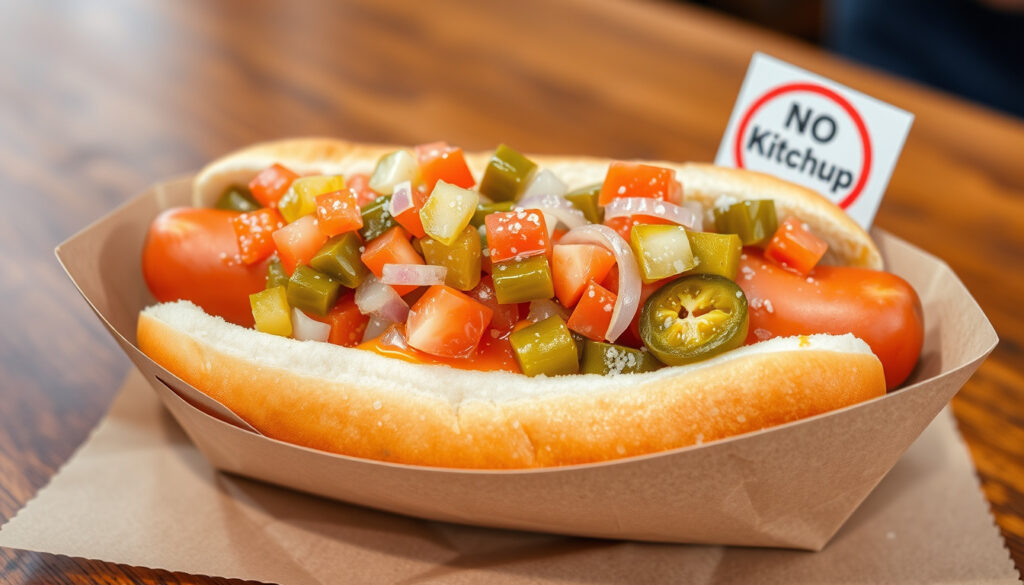
Chicago Style Hot Dog: 7 Toppings, Recipe & No Ketchup
Chicagoans treat ketchup on a hot dog as a culinary insult—and they have seven toppings to prove it. The Chicago-style hot dog enforces a strict no-ketchup rule and exacting seven-topping standard that locals guard with genuine pride.
Toppings Count: 7 · Bun Type: Poppy seed · Key Rule: No ketchup · Hot Dog Type: All-beef, natural casing · Classic Brand: Vienna Beef
Quick snapshot
- 7 toppings standard per Wikipedia (encyclopedic reference)
- Poppy seed bun is the traditional vessel (Wikipedia (encyclopedic reference))
- Vienna Beef and Red Hot Chicago are the two dominant manufacturers (Wikipedia (encyclopedic reference))
- Exact year the seven-topping standard was formalized
- Precise origin of the no-ketchup rule
- When Rosen’s popularized the poppy seed bun combination
- German immigrants brought hot dog traditions to Chicago in the late 1800s
- Mid-20th century saw the Chicago dog formally established as a regional variant
- The “Mother-in-Law” variant was reportedly invented at Fat Johnnie’s on the South Side (1950s–1970s)
- Chicago hot dog vendors continue enforcing no-ketchup policies
- Regional variations like the Depression Dog maintain tradition alongside the classic
- Authenticity debates persist as newcomers request modifications
| Attribute | Standard Value |
|---|---|
| Standard Toppings | Mustard, onions, relish, pickle, tomato, sport peppers, celery salt |
| Bun | Steamed poppy seed |
| Hot Dog | Natural-casing all-beef |
| Ketchup Status | Prohibited |
What Makes a Hot Dog Chicago-Style?
A Chicago-style hot dog isn’t simply a hot dog with extra toppings. It’s a specific construction with rules that most Chicagoans consider sacred. The combination of an all-beef frankfurter on a poppy seed bun, topped with exactly seven ingredients in a particular order, defines the authentic version.
Key ingredients
The frankfurter must be all-beef with a natural casing, which gives that distinctive snap when you bite into it. Vienna Beef and Red Hot Chicago are the two most prominent manufacturers serving Chicago’s hot dog stands (Wikipedia, encyclopedic reference). The hot dog is traditionally steamed or boiled in hot water before the toppings go on (Wikipedia, encyclopedic reference).
Bun requirements
The poppy seed bun is not negotiable for traditionalists. A plain bun may be substituted only if poppy seed buns are unavailable (Craftsy, culinary instruction platform). The bun is typically steamed alongside the hot dog, creating a soft vessel that holds all seven toppings.
Preparation method
To heat the hot dog properly, simmer it in about an inch of water in a skillet until heated through (Craftsy, culinary instruction platform). A less common alternative is charcoal grilling, creating what Chicagoans call a “char-dog” (Wikipedia, encyclopedic reference).
What Are the 7 Condiments on a Chicago Hot Dog?
The seven toppings on a Chicago hot dog are arranged with intention, each adding something specific: tang, crunch, heat, or freshness that creates a balanced bite (Odi Forgo, recipe blog). The bright green sweet pickle relish—often described as “neon green”—is one of the most visually distinctive elements (Sun Outdoors, travel lifestyle publication).
List of exact toppings
Starting from the bottom and building up, the seven toppings are:
- Yellow mustard — applied directly to the hot dog as a sharp, tangy element
- Chopped white onions — adding crunch and sharpness
- Bright green sweet pickle relish — providing slight sweetness for contrast
- Dill pickle spear — briny and crisp, placed on one side opposite the tomato
- Tomato slices or wedges — two small wedges per hot dog offering fresh, juicy elements
- Sport peppers — two whole peppers typically, adding heat
- Celery salt — a light sprinkle on top for a subtle herbal finish
Sport peppers explained
Sport peppers are a Capsicum annuum variety, small spicy green peppers typically packed in vinegar (Wikipedia, encyclopedic reference). Two whole sport peppers are typically placed on top of a Chicago-style hot dog (Craftsy, culinary instruction platform). They provide just enough heat to balance the other toppings without overwhelming them.
“Each topping on a Chicago dog adds something specific: tang, crunch, heat, or freshness, creating a balanced bite.”
— Odi Forgo (recipe publication)
What’s the Difference Between a New York Style Hot Dog and a Chicago-Style Hot Dog?
Two iconic American hot dog styles dominate the conversation, and their differences go beyond geography. The Chicago dog stands as a stark counterpoint to New York dogs (National Hot Dog and Sausage Council, industry trade body).
NY toppings
New York style hot dogs typically feature Sabrett brand sausages, served with sauerkraut, onions, and mustard. The sauerkraut adds a sour, cabbage-forward flavor that Chicago dogs simply don’t include. The iconic Sabrett carts with their onions cooked into the sauce give NY dogs their distinctive character.
Chicago rules
Chicago refuses the sauerkraut entirely and imposes the most rigid topping code of any American city. Where New York allows flexibility, Chicago demands precision. The seven-topping rule, the poppy seed bun, and the absolute prohibition on ketchup define the Windy City standard.
New York offers adaptability; Chicago demands purity. Vendors on both coasts report that customers who move between cities often struggle with the other style’s rules.
The pattern reveals itself: New York treats hot dogs as a customizable backdrop for various toppings, while Chicago views the hot dog itself as a finished product requiring no improvisation from the customer.
| Feature | New York Style | Chicago Style |
|---|---|---|
| Primary brand | Sabrett | Vienna Beef or Red Hot Chicago |
| Bun type | Steamed sponge roll | Poppy seed bun |
| Standard toppings | Mustard, sauerkraut, onions | Mustard, onions, relish, pickle, tomato, sport peppers, celery salt |
| Ketchup | Accepted | Prohibited |
| Signature element | Sauerkraut | Sport peppers, neon green relish |
| Cooking method | Steamed or grilled | Steamed, boiled, or char-broiled |
Visitors moving between cities quickly learn that the rules differ—and that asking for ketchup in Chicago invites genuine disapproval from vendors who take the tradition seriously.
Why Is Ketchup Not Allowed on Chicago Hot Dogs?
The no-ketchup rule on Chicago-style hot dogs is more than a preference—it’s an unwritten code that vendors enforce with genuine conviction. Ketchup is never used on a Chicago-style hot dog (Craftsy, culinary instruction platform), and some Chicago hot dog stands do not even offer ketchup as a topping option (Craftsy, culinary instruction platform).
Historical reasons
The rule reportedly dates back to the 1940s, emerging as Chicago dog culture solidified around the seven-topping standard. Adding ketchup was seen as masking the flavors of quality beef and the carefully balanced toppings. The prohibition became a marker of authenticity—someone who reaches for ketchup signals they don’t understand the Chicago way.
Local tradition
Chicago vendors take this seriously. Asking for ketchup at a traditional stand can earn you a lecture, a warning, or in some cases, a refusal to serve. The rule is so embedded that it functions as a social test: knowing to skip the ketchup marks you as someone who respects the tradition.
“The Chicago dog is described as the possible antithesis to New York dogs—where New York accepts condiments freely, Chicago demands restraint.”
— National Hot Dog and Sausage Council (industry trade body)
For newcomers, the no-ketchup rule serves as an immediate test of whether they understand the cultural weight behind Chicago’s hot dog tradition.
Chicago-Style Hot Dog Recipe
Making an authentic Chicago-style hot dog at home requires attention to order and proportion. The sequence matters because each topping should be visible and accessible, not buried.
Ingredients list
- 1 all-beef frankfurter with natural casing (Vienna Beef recommended)
- 1 poppy seed hot dog bun
- Yellow mustard
- Chopped white onions
- Bright green sweet pickle relish
- 1 dill pickle spear
- 2 tomato wedges
- 2 whole sport peppers
- Celery salt
Step-by-step assembly
Heat the frankfurter by simmering in about an inch of water in a skillet until heated through (Craftsy, culinary instruction platform). Steam the poppy seed bun briefly. Place the hot dog in the bun.
- Apply yellow mustard in a zigzag pattern directly on the hot dog
- Sprinkle a generous amount of chopped white onions
- Add bright green sweet pickle relish
- Place the dill pickle spear on one side of the bun, opposite where you’ll put the tomato
- Tuck two tomato wedges (cut in half-circles) between the bun and hot dog
- Place two whole sport peppers on top
- Lightly sprinkle celery salt over everything
Tomato should be cut in half to form two half circles and tucked between the bun and hot dog (Craftsy, culinary instruction platform). Some vendors at Superdawg drive-ins substitute a pickled tomato for fresh tomato in their Chicago-style hot dogs (Wikipedia, encyclopedic reference)—an acceptable variation, but not the traditional approach.
Confirmed vs Unconfirmed
Confirmed facts
- The seven standard toppings are mustard, onions, relish, pickle, tomato, sport peppers, and celery salt
- Ketchup is prohibited on authentic Chicago hot dogs
- Poppy seed buns are traditional; plain buns are acceptable substitutes
- Sport peppers are a Capsicum annuum variety pickled in vinegar
- Two sport peppers typically top each dog
Unclear or debated
- The exact year the seven-topping standard was formalized
- Precise historical origin of the no-ketchup prohibition
- When the poppy seed bun combination became standard (early-to-mid 20th century)
- The “Mother-in-Law” name origin (one vendor link to heartburn is reportedly disputed)
Related reading: How Many Cups in a Gallon · 1 Quart to Cups
youtube.com, chicagostyledog.com, thetakeout.com, styleatacertainage.com
Chicago’s hot dog tradition pairs perfectly with the city’s hearty deep-dish pizza recipe, another layered classic born from the same innovative food scene.
Frequently asked questions
What bun is used for a Chicago style hot dog?
A poppy seed bun is the traditional choice for a Chicago-style hot dog. If poppy seed buns are unavailable, a plain bun may be substituted, though purists will notice the difference.
How many calories in a Chicago style hot dog?
A full Chicago-style hot dog with all seven toppings typically ranges from 400-500 calories, depending on the size of the frankfurter and the amount of each topping applied.
Where can I find a Chicago style hot dog near me?
Outside Chicago, look for specialty hot dog stands, gourmet food courts, or restaurants that list regional American hot dog styles. Vienna Beef products may be available at butcher shops or specialty grocers.
What is Vienna Beef in Chicago hot dogs?
Vienna Beef is one of two prominent Chicago hot dog manufacturers (alongside Red Hot Chicago). Their all-beef frankfurters with natural casings are the brand most commonly associated with authentic Chicago-style hot dogs.
Are there variations to the standard Chicago dog?
Common exceptions include adding cucumber slices or lettuce, omitting poppyseeds or celery salt, using plain relish, or using skinless hot dogs. The “Depression Dog” is a simpler version with only mustard, onions, plain relish, and sport peppers.
What is the “Mother-in-Law” hot dog variant?
The “Mother-in-Law” consists of all Chicago-style fixings on a Chicago-style tamale instead of a frankfurter. It was reportedly invented by John Pawlikowski at Fat Johnnie’s in Chicago’s South Side neighborhood.
For visitors to Chicago, the choice between standing at a cart in Lincoln Park or pulling into Superdawg’s drive-in is more than convenience—it’s a statement about how you want your beef, your bun, and your seven toppings to meet. The Windy City’s hot dog culture rewards those who respect the code: skip the ketchup, embrace the sport peppers, and eat it before the bun gets soggy.
More related posts
 Supreme Court Rejects Parental Rights Case: What It Means
 Matilda the Musical (Film): Netflix Age Rating & Kids Guide
 What National Day Is Today? Picnic Day & World Book Day
 Galaxy A03s to Buy: Price, Specs, and 2025 Verdict
 What Is Hydroxyzine Used For? Uses, Dosage & Side Effects
 Forest Whitaker Movies and TV Shows: Full Filmography & FAQ
 FC Barcelona vs Como 1907 Lineups: Yamal Penalty and Injury
 Tulsa King Season 2: Episodes, Ending, and Season 3 Updates
