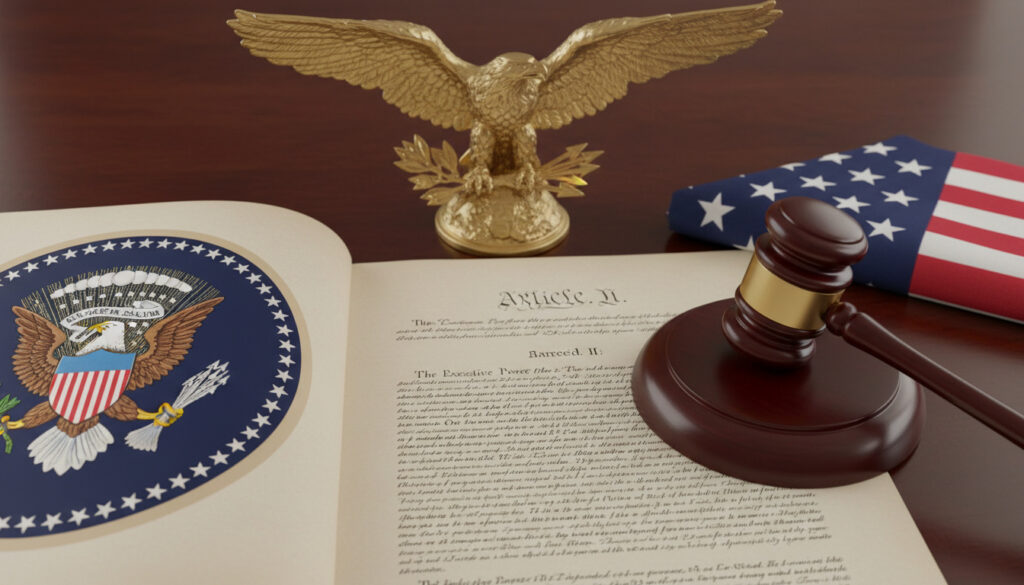
Article 2 of the Constitution – Powers, Qualifications and Impeachment Explained
Article II of the United States Constitution establishes the executive branch, vesting all federal executive power in a single President elected to a four-year term. The text creates a unitary executive designed to provide energy and dispatch in government operations while remaining accountable to the people through elections and congressional oversight.
Ratified in 1788, this article outlines the qualifications for office, the Electoral College method of selection, and the specific powers granted to the chief executive. It also establishes the mechanism for removing officials through impeachment, creating a framework that balances strong leadership against the dangers of concentrated authority.
The provisions remain substantially unchanged since ratification, though four constitutional amendments have modified specific procedures regarding elections, terms of office, succession, and disability.
What Does Article 2 of the Constitution Say?
The full text organizes executive authority into four distinct sections addressing the office’s foundation, powers, duties, and removal. These provisions reveal a carefully constructed balance between empowering decisive action and preventing monarchical abuse.
Executive Vesting
Vests executive power in a single President with a four-year term
Qualifications & Election
Outlines natural-born citizenship, age requirements, and Electoral College selection
Presidential Powers
Details authority as Commander in Chief, treaty-making, and appointments
Removal Mechanism
Impeachment process for treason, bribery, or high crimes and misdemeanors
Key Constitutional Principles
- Unitary Executive: All executive power resides in one individual, avoiding the weakness of committee leadership experienced under the Articles of Confederation.
- Electoral Indirection: States appoint electors who formally select the President, originally designed as a deliberative buffer between populace and executive.
- Qualified Citizenship: Only natural-born citizens (or those citizens at adoption) may serve, reflecting concerns about foreign influence.
- Senate Checks: Treaty ratification and major appointments require Advice and Consent of two-thirds of Senators present.
- Term Limitations: While the original text allowed unlimited terms, the 22nd Amendment now restricts Presidents to two elected terms.
- Accountability Mechanisms: Impeachment provides congressional remedy for serious misconduct, while regular elections ensure popular control.
| Aspect | Constitutional Provision | Modern Application |
|---|---|---|
| Executive Vesting | Section 1 vests power in single President | Unitary executive doctrine affirmed by courts |
| Term Length | Four Years | Limited to two terms by 22nd Amendment |
| Citizenship | Natural born Citizen required | Contested in cases of foreign birth to US parents |
| Age & Residency | 35 years old, 14 years resident | Strictly enforced; no exceptions granted |
| Electoral Method | State-appointed Electors vote | 12th Amendment separates President/VP ballots |
| Commander in Chief | Directs Army, Navy, Militia | Presidents deploy without war declarations |
| Treaty Power | Senate 2/3 consent required | Executive agreements circumvent treaty route |
| Appointments | Major officers require Senate consent | Recess appointments limited by Supreme Court |
| Pardon Power | Reprieves and Pardons except impeachment | Used extensively by recent administrations |
| State of Union | Periodic reporting to Congress | Annual televised address tradition since 1923 |
| Faithful Execution | Take Care Clause | Basis for regulatory enforcement discretion |
| Impeachment | Treason, bribery, high crimes | Three Presidents impeached, none removed |
What Are the Qualifications and Election Process for President Under Article 2?
Constitutional Requirements for Office
Section 1 establishes three absolute qualifications for the presidency. Candidates must be natural born Citizens, or Citizens of the United States at the time of the Constitution’s adoption—a grandfather clause now irrelevant as no pre-adoption citizens survive. They must have attained the Age of thirty five Years and been fourteen Years a Resident within the United States.
The natural-born citizen requirement has generated modern legal debate regarding candidates born abroad to American parents. Challengers have questioned the eligibility of Senator John McCain (born in Panama) and Senator Ted Cruz (born in Canada to a U.S. citizen mother), though legal consensus generally sustains their eligibility through parental citizenship.
Contemporary candidates occasionally face scrutiny regarding the natural-born citizen clause. While the Supreme Court has never ruled definitively on foreign-born candidates with American parents, historical practice and statutory law suggest such individuals meet the Article II standard.
The Electoral College System
Rather than direct popular vote, the Electoral College provides the selection mechanism. Each state appoints Electors equal to its congressional delegation (Senators plus Representatives), who then vote for President and Vice President. Congress determines the uniform date for presidential elections.
If no candidate achieves a majority of electoral votes, the House of Representatives selects the President from among the top three candidates, with each state delegation casting one vote. This contingency occurred in 1824, when the House chose John Quincy Adams despite Andrew Jackson winning a plurality of popular and electoral votes.
What Powers and Duties Does Article 2 Assign to the President?
Military and Foreign Affairs Authority
As Commander in Chief, the President directs all armed forces operations. This authority has expanded significantly since 1787, with modern Presidents committing troops to extended conflicts without formal declarations of war, as seen during the Civil War, World War II, and post-9/11 military engagements.
Diplomatic power includes receiving ambassadors and negotiating treaties, though the Senate must approve treaties by two-thirds vote. The President also nominates ambassadors, Supreme Court justices, and principal officers of the executive departments, subject to Senate confirmation.
Clemency and Administrative Powers
The President grants Reprieves and Pardons for federal offenses, except in cases of impeachment. Recent administrations have utilized this power extensively, including President Trump’s over 140 pardons and President Biden’s pardon of his son Hunter Biden. The limitation regarding impeachment means presidential clemency cannot reverse an impeachment conviction or prevent removal from office.
While the pardon power is broad, Article II explicitly excludes its use in impeachment cases. This ensures that congressional removal remains beyond executive reversal, maintaining the separation of powers even in matters of mercy.
When the Senate recesses, the President may fill vacancies by granting temporary commissions that expire at the session’s end. However, the Supreme Court significantly restricted this authority in 2014, ruling that pro forma sessions prevent the occurrence of a genuine recess.
Legislative and Reporting Responsibilities
Section 3 requires the President to periodically inform Congress on the State of the Union and recommend necessary measures. This evolved from written messages into the annual televised address tradition begun with President Coolidge’s 1923 radio broadcast.
The President may convene both houses on extraordinary occasions and adjourn them when they disagree on timing. The Take Care Clause mandates faithful execution of laws, providing constitutional basis for regulatory enforcement and presidential discretion in implementation.
What Does Article 2 Section 4 Say About Impeachment?
Section 4 establishes the mechanism for removing the President, Vice President, and all civil Officers for Treason, Bribery, or other high Crimes and Misdemeanors. The House of Representatives holds the sole power of impeachment (charging), while the Senate tries all cases, requiring two-thirds conviction for removal. For further details on the executive branch, you can explore the ${difesa italiana} article. difesa italiana
Historical application includes the impeachments of Andrew Johnson (1868), Bill Clinton (1998), and Donald Trump (2019 and 2021). None resulted in Senate conviction or removal. The phrase “high Crimes and Misdemeanors” encompasses serious abuses of office and violations of public trust beyond statutory crimes, though interpretations vary regarding its precise scope.
Impeachment results in removal and disqualification from future office, but does not exempt the individual from standard criminal prosecution. The double jeopardy clause does not apply, as impeachment constitutes a political rather than criminal sanction.
How Has Article 2 Changed Through Amendments?
While the original text remains largely intact, four amendments have substantially altered its operation:
- 1787: Article II drafted at the Constitutional Convention, establishing the single executive model proposed by Alexander Hamilton and others.
- 1804: The 12th Amendment ratified following the 1800 electoral tie between Thomas Jefferson and Aaron Burr, mandating separate Electoral College votes for President and Vice President.
- 1933: The 20th Amendment shifted the presidential inauguration from March 4 to January 20, reducing lame-duck periods and moving congressional sessions forward.
- 1951: The 22nd Amendment imposed term limits following Franklin D. Roosevelt’s four elected terms, restricting Presidents to two terms or a maximum ten years if assuming office mid-term.
- 1967: The 25th Amendment clarified presidential disability procedures, establishing vice presidential succession and mechanisms for declaring presidential incapacity through cabinet or congressional commission.
What Remains Original vs. Amendment-Modified?
| Unchanged Original Provisions | Procedures Modified by Amendments |
|---|---|
| Vesting of executive power in single President | Electoral College voting procedure (12th Amendment separated President and VP ballots) |
| Natural born citizen, age 35, 14-year residency requirements | Inauguration date moved from March 4 to January 20 (20th Amendment) |
| Commander in Chief authority | Term limits restricting to two elected terms (22nd Amendment) |
| Impeachment standard (treason, bribery, high crimes) | Disability and succession procedures (25th Amendment) |
| Presidential oath text and compensation protection | Contingent election procedures (House selects President, Senate selects VP under 12th) |
Why Did the Framers Create a Unitary Executive?
The Constitutional Convention debates and subsequent Federalist Papers reveal deliberate rejection of the weak plural executive under the Articles of Confederation. Alexander Hamilton argued in Federalist 70 that “unity” in the executive branch ensures accountability, prevents destructive factionalism, and enables decisive action during emergencies.
The Framers balanced this energetic unitary executive against monarchy fears through multiple constraints. The Senate’s role in treaties and appointments, Congress’s impeachment power, and fixed four-year terms with electoral accountability provided sufficient checks without paralyzing the executive. The Electoral College originally served as a deliberative filter, though it evolved into a largely ceremonial ratification of state popular votes.
This design reflects 18th-century political science emphasizing separation of powers and the need for vigorous execution of laws. The single executive could act with “dispatch” while remaining responsible to the people through regular elections—a sharp contrast to the hereditary monarchs of Europe.
What Did the Framers Say About Executive Power?
“Energy in the Executive is a leading character in the definition of good government. It is essential to the protection of the community against foreign attacks; it is not less essential to the steady administration of the laws; to the protection of property against those irregular and high-handed combinations which sometimes interrupt the ordinary course of justice.”
— Alexander Hamilton, Federalist 70
“The executive Power shall be vested in a President of the United States of America.”
— Article II, Section 1, U.S. Constitution
Summary of Article 2 Essentials
Article II establishes a unitary executive led by a President serving four-year terms, elected through the Electoral College system, and subject to strict qualifications regarding citizenship, age, and residency. The article grants substantial powers including military command, treaty negotiation, appointment authority, and clemency, while requiring faithful law execution and regular reporting to Congress. Removal occurs only through impeachment for treason, bribery, or high crimes. While four amendments have refined electoral procedures and term limits, the fundamental structure of a single energetic executive balanced by congressional checks remains as the Framers designed in 1787.
Frequently Asked Questions About Article 2
What is the exact text of the presidential oath?
The oath requires the President to swear or affirm that they will faithfully execute the office and preserve, protect, and defend the Constitution to the best of their ability. Chief Justice John Roberts administered the most recent oaths.
Can the President pardon anyone for any crime?
The pardon power extends to all federal offenses but explicitly excludes impeachment cases. It does not apply to state crimes, and acceptance of a pardon traditionally implies guilt.
What happens if no candidate wins the Electoral College?
The House of Representatives selects the President from the top three candidates, with each state delegation casting one vote. The Senate chooses the Vice President from the top two candidates.
How does the 25th Amendment interact with Article 2?
The 25th Amendment clarifies Article 2’s silence on presidential disability, establishing procedures for temporary transfer of power to the Vice President and filling vice presidential vacancies.
What constitutes “high crimes and misdemeanors”?
This standard includes serious abuses of office, violations of public trust, and conduct injurious to the state, not merely statutory felonies. Historical interpretations vary among constitutional scholars.
Does Article 2 require the State of the Union as a speech?
The text requires only that the President inform Congress on the State of the Union. Thomas Jefferson began the written message tradition, while Woodrow Wilson revived oral delivery in 1913.
Can Congress change the presidential salary?
Congress sets compensation, but the Emoluments Clause prohibits changing the salary during a President’s elected term, preventing legislative pressure through financial threats or inducements.
More related posts
 Is Vivid Seats Legit? 2026 Safety Review & Buyer Guarantee
 University of Arizona Online: Rankings, Tuition & Reviews
 The Pitt Season 2 Release Date, Cast Changes & Schedule
 Who Is the Tallest Person in the World? Current Records
 Lana Del Rey Tour 2026: Dates & Tickets Update
 How Many Cups in a Gallon: US, UK & Dry Conversion Guide
 Woman in the Window: Twist, Killer, Ending & Worth Watching
 Raven of the Inner Palace: Complete Anime and Light Novel Guide
