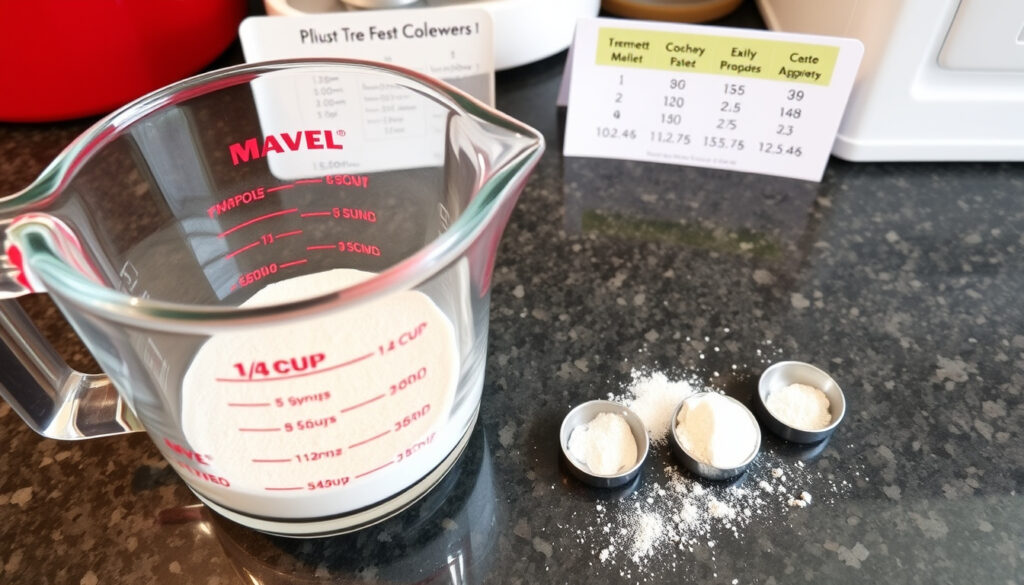
How Many Tablespoons in 1/4 Cup? 4 tbsp & Conversion Chart
You’re halfway through a cookie recipe and the measuring cup for 1/4 cup is buried in the drawer. Your tablespoon set is right there, and you wonder: can I just use that instead? Yes — 1/4 cup equals exactly 4 tablespoons in the US customary system, a conversion that keeps thousands of recipes on track.
1/4 cup to tablespoons: 4 tbsp · 1 cup to tablespoons: 16 tbsp · 1/2 cup to tablespoons: 8 tbsp · 1/3 cup to tablespoons: 5 tbsp + 1 tsp
Quick snapshot
- 1/4 cup = 4 tablespoons (Kitchen Serf (cooking resource))
- 1/4 cup = 12 teaspoons (Lively Table (conversion guide))
- 1/4 cup ≈ 60 mL (Weekend Bakery (baking conversions))
- Many cooks believe 3 tablespoons equals 1/4 cup — it does not. The correct amount is 4 tablespoons (Lively Table (conversion guide))
- The US customary system standardized the cup at 240 mL under NIST guidance, cementing the 16-tablespoon-per-cup rule (NIST (U.S. weights and measures authority))
- Master larger conversions like cups to gallons and quarts to cups for any recipe
Four key facts, derived from official definitions: the 1/4-cup measurement stays consistent regardless of ingredient.
| Measurement | Equivalent | Source |
|---|---|---|
| 1/4 cup | 4 tablespoons (US) | Kitchen Serf (cooking resource) |
| 1/4 cup | 12 teaspoons | Lively Table (conversion guide) |
| 1/4 cup | 2 fl oz | Derived from NIST (U.S. weights and measures) 1 cup = 8 fl oz |
| 1/4 cup | 60 mL (approx.) | Weekend Bakery (baking conversions) |
How Many Tablespoons Are in 1/4 Cup?
The Exact Answer: 4 Tablespoons
- The simple conversion: 1/4 cup = 4 tablespoons (Kitchen Serf (cooking resource)).
- This holds for any ingredient — butter, flour, water, sugar — because volume is independent of weight.
If a recipe calls for 1/4 cup of butter, you can scoop out 4 level tablespoons. The same applies to liquids: 4 tablespoons of milk fill the same 1/4-cup space as 4 tablespoons of oil.
A single tablespoon error turns a delicate cake batter too thin or too dry. Getting the 4-tablespoon count right separates a light crumb from a dense brick.
Does 3 Tablespoons Equal 1/4 Cup?
- No — 3 tablespoons is 1/4 cup minus 1 tablespoon, or about 18% less volume (Lively Table (conversion guide)).
This is one of the most persistent measurement myths in home kitchens. Many online forums and even some recipe cards mistakenly round down. Using 3 tablespoons instead of 4 can skew the liquid balance of a dough or batter, especially in recipes that rely on precise hydration.
The implication: when in doubt, revert to the official 4-tablespoon rule. A quick count with your tablespoon set is more reliable than memory.
How Many Teaspoons in 1/4 Cup?
- 1/4 cup = 12 teaspoons (since 1 tablespoon = 3 teaspoons) (Lively Table (conversion guide)).
If your tablespoon is missing, use a teaspoon: 12 level scoops give you exactly 1/4 cup. That’s 3 teaspoons per tablespoon times 4 tablespoons.
The pattern: every tablespoon equals 3 teaspoons, so scaling up or down is straightforward arithmetic — no need for a calculator.
How Many Tablespoons in a Cup?
Tablespoons in 1 Cup: 16
- 1 US cup = 16 tablespoons (Lively Table (conversion guide)).
This is the cornerstone of US volume measurement. Once you know 16 tablespoons fill one cup, every fraction becomes a simple division: 1/2 cup is 8 tablespoons, 1/4 cup is 4, and 1/3 cup lands between them.
Professional bakers rely on the 16-piece puzzle because it eliminates guesswork. Splitting a cup into tablespoons gives you precision down to 1/16 of a cup — far finer than most measuring cups offer.
Tablespoons in 1/2 Cup: 8
- 1/2 cup = 8 tablespoons (The Harvest Kitchen (recipe conversion)).
Half a cup is the most common fraction in baking. Using tablespoons, you can measure 1/2 cup by adding 8 level scoops — no need to hunt for a 1/2-cup measure.
Tablespoons in 1/3 Cup: 5 1/3
- 1/3 cup = 5 tablespoons + 1 teaspoon (since 1/3 of 16 is 5.33) (The Harvest Kitchen (recipe conversion)).
One-third cup requires a mixed measurement: 5 full tablespoons plus 1 teaspoon. That extra teaspoon accounts for the fractional tablespoon. Use a 1/3 measuring cup for speed, but for absolute accuracy the spoon method works.
Does 8 Tablespoons Equal 1 Cup?
- No — 8 tablespoons equals 1/2 cup, not 1 cup (Lively Table (conversion guide)).
This confusion is common. When a recipe says “8 tablespoons,” it is half a cup, not a full one. Doubling 8 tablespoons gives you 1 cup (16 tablespoons).
The trade-off: misreading this conversion can double or halve your ingredient. Check the original recipe’s units before measuring.
What Is a Dry Measuring Cup?
Definition of a Dry Measuring Cup
- Dry measuring cups are designed for dry ingredients like flour, sugar, and oats (King Arthur Baking Company (professional baking authority)).
Dry cups come in nested sets — typically 1/4, 1/3, 1/2, and 1 cup — with straight rims that let you level off excess with a knife. This ensures you pack or scoop consistently.
Dry vs Liquid Measuring Cups: Key Differences
- Liquid measuring cups have spouts and are made of glass or clear plastic with measurement lines on the side (King Arthur Baking Company (professional baking authority)).
Using a liquid cup for dry flour compacts the ingredient and changes the volume. Using a dry cup for milk makes pouring messy and inaccurate. The two tools serve different purposes.
When to Use Each Type
- Use dry cups for dry ingredients: scoop and level.
- Use liquid cups for water, oil, milk: pour to the marking at eye level.
The rule: never measure liquid in a dry cup or dry in a liquid cup. For ingredients like butter, which come in stick form, tablespoons are the most reliable tool. If you’re unsure about conversions, you can find out how to translate english to spanish at $translate english to spanish.
“Accurate measurement is the difference between a good bake and a great one. Use the right cup for the ingredient.”
King Arthur Baking Company Measuring Guide
The catch: using the wrong cup type adds unnecessary variation to your measurements.
Four measurement facts, one pattern: the tablespoon is the universal unit that bridges cup fractions and spoon sets. Mastering it makes every recipe manageable.
Why this matters: a single tablespoon error in a 1/4 cup conversion can throw off hydration ratios, altering texture and bake time. Consistency starts with knowing the number.
Confirmed Facts vs Common Misconceptions
Confirmed Facts
- 1/4 cup = 4 tablespoons
- 1 cup = 16 tablespoons
- 1/2 cup = 8 tablespoons
- 1 tablespoon = 3 teaspoons
What’s Unclear
- 3 tablespoons equals 1/4 cup (false — it’s 4)
- 8 tablespoons equals 1 cup (false — it’s 1/2 cup)
“The US customary cup is defined as 16 US tablespoons, a standard established to ensure consistency across commercial and household measurements.”
National Institute of Standards and Technology, Handbook 44
For home bakers and recipe writers, the decision is clear: commit the 1/4-cup = 4-tablespoon equivalence to memory, or risk a dish that’s off by a full 25% of its intended volume.
For a detailed breakdown of this quarter cup to tablespoons conversion, including common mistakes and a printable chart, check out the full guide.
Frequently asked questions
How many tablespoons in 1/8 cup?
1/8 cup equals 2 tablespoons.
How many tablespoons in 1/6 cup?
1/6 cup equals about 2 tablespoons plus 2 teaspoons (since 1/6 of 16 = 2.66 tbsp).
How many tablespoons in 2/3 cup?
2/3 cup equals 10 tablespoons plus 2 teaspoons.
How many tablespoons in 3/4 cup?
3/4 cup equals 12 tablespoons.
How many tablespoons in 1/4 cup of butter?
1/4 cup of butter equals 4 tablespoons, or half a standard stick (8 tbsp per stick).
More related posts
 Mission Impossible Dead Reckoning Part 2: 2025 Release & Flop
 Toyota RAV4 Hybrid Ireland: Cost, Reliability & Best Years
 What National Day Is Today? Picnic Day & World Book Day
 How to Delete Apps on Mac – Complete Guide for All Methods
 Fast and Furious Movies in Order – Release and Chronological Guide
 Free Lyrics KPop Demon Hunters: English, Romanized, Meaning
 Nissan Frontier Pro-4X: Specs, Reliability & Reviews 2026
 Wish You Were Here: Story, Meaning & Funeral Suitability
